Showing posts with label spaces. Show all posts

Saturday, January 26, 2013

Incorporating ART into Our Living Spaces


So, you have finally got your dream house or apartment. All the fixtures and fittings have been impressively installed, and you have even bought the right decorative items to be positioned tastefully in your new home along with the furniture. All that begs to be “dressed” are the bare walls of various hues. Now, what would you choose to deck on those walls?

Pearl Lam Hong Kong Gallery

I would like to offer a humble suggestion here. How about buying an art piece instead of the usual wall hanging fare?

Pearl Lam Shanghai Gallery

Art, in all its broad definition, have helped shaped the spaces of our homes, offices and even hospitals. There are many different forms of art. From paintings, murals on walls, sculptures and etc. All we need to do is walk into a museum, or an art gallery to see how art has evolved over centuries; and thereby reflecting the changes in our society. In many ways, the art works of various centuries act like a mirror. They show us a peek into the culture of that particular era. From the great masters such as Michaelangelo, Leonardo da Vinci, to Monet, Renoir, Van Gogh, Picasso, Dali to Andy Warhol, Keith Haring and so forth. Each artist had captured their perspective of the world around them of that time.

Of course, art is a very personal and subjective topic. What is praised as a masterpiece by an individual or group may be dismissed as nothing more than child’s play by another. Henry David Thoreau famously said, It's not what you look at that matters, it's what you see”. 

To this day, for the life of me, I still do not know how to appreciate a Jackson Pollock painting. However, there are many who do. Respected art specialists around the world have assessed his works to be worthy of its hefty price tag. Hence, art is something that speaks to the individual. What makes art different from the other wall hanging accents is that it could appreciate in value, depending on the artist who created it. In this respect, art is one of the most unique decorative items that we can procure to not only enhance our habitat, it can even become a priceless investment if we bought the works of a much sought after artist. 

When a society becomes more affluent, households can afford to deck their homes with all kinds of impressive “gadgets” and shiny “toys”. For some, art collection can become a passion. For others, it is a practical way of diversifying one’s investment portfolio. So, how do we really know which art to buy, collect or invest in? There are several local Malaysian respected artists such Ibrahim Hussein, Eng Tay and Chang Fee Ming to name a few. However, I wanted to understand the growing global fascination with the Chinese contemporary art. Of late, Chinese artists have been garnering a lot of media attention in the art world. Not to mention, how the prices of their art works have been rising consistently. As I had the pleasure to meet with Ms. Pearl Lam who was recently in Kuala Lumpur, I decided to consult her expert opinions on this genre.

Ms. Pearl Lam

Pearl Lam is a Hong Kong native. She is the owner and founder of “Pearl Lam Galleries” in both Shanghai and Hong Kong, and also, the “China Art Foundation”. In addition, she is a curator, collector and patron of the arts. Pearl defines Chinese contemporary art “as reinvention of traditions reacting or embracing western influences to create new expression”. What I admire about Pearl is that she is not only an art gallery owner, she is a passionate advocator of contemporary art.

Pearl Lam Hong Kong Gallery

Pearl Lam Galleries has been advocating in the promotion and re-evaluation of the philosophy, perceptions and aesthetics of Chinese art for almost 20 years. Pearl has even funded an “artist-in-residence program” for artists and designers worldwide, where by they are invited to push the boundaries of traditional Chinese art and craft techniques in order to create new works that reflect their experiences in China. 

Yinghua's Art Piece

Her work as a curator was much recognized in the acclaimed exhibition entitled, “Awakening: La France Mandarin”. It was an exhibition of the French influence on Chinese art, which was a central part of the 2004 'French Year in China’. The exhibition was staged in the Urban Planning Museum, Shanghai and at Beijing's National Gallery of Art.


Su Xiaobai's One Line of Whiteness

As a patron, Pearl has donated many art works to the museums around the world. This includes the Victoria & Albert Musuem in London, the Asia Art Society Museum in New York, the KW Institute in Berlin, the Museum of Art and Design in New York, the Peabody Museum in Boston and the Metropolitan Museum in New York. Therefore, Pearl is definitely more than qualified to dispense advice on Chinese contemporary art.


Zhu Jinshi's Who Will Write Wei Bei with Me?

Pearl shares, “I love Chinese contemporary art that has a Chinese structure or language but it is contemporary versus Chinese art that has western structure or language with Chinese content, which, for me is a derivative.”

Pearl explains, “Chinese has been searching the contemporary identity in art while the West has been interested in Eastern spirituality which has made Chinese contemporary abstract art become "hot" to collect.”

So, I asked Pearl what she likes to collect. After all, if she personally collects art works from a certain artist, it must be worth looking into.

Jason Martin's Turca

This was Pearl’s reply, “Chinese contemporary abstract, which is derived from ink brush cultural based upon Daoism and Buddhism, is what I recently love to collect. It is distinctively different from Western Abstract expressionism, Chinese abstract is based on Chinese philosophy like Daoism’s "Form is Formless" or the Buddhism Diamond Sutra that questions Truth based on perception.” 

The “hot” Chinese contemporary artists that Pearl recommends for collectors and investors alike are Zhu Jinshi, Su Xiaobai and Yinghua. The Western abstract artists are Jason Martin and Jim Lambie. Sample of their work can be seen in the accompanying photographs.


Jim Lambie's Metal Box (Butterfly and Orchid)

Pearl labels “collectors” as people who have bought artworks from a certain artist because they believed in the artist, and that they are passionate about the works. They are not so concerned whether the prices of these artworks will go up or down. To them, the collected art works itself give them tremendous pleasure or enjoyment. They love the artworks purely for the art itself.

However, an investor has a different point of view. These collectors take calculated risk, and would be very disturbed if their artworks have diminished in value. They seek to gain a return on their art investments, as this is their primary focus in procuring the artworks. Therefore, these investors may only hold each artwork for no more than 10 to 15 years. They will seek to sell their artistic investment when the prices start to appreciate.

So, whether you choose to be an investor or a collector, it would be wise to gather as much research and knowledge about the artists in question. In addition, consult with various art specialists, galleries and art magazines. All these would undoubtedly assist you in making a more educated decision in your art acquisition. Art investment is nothing like buying a piece of furniture or a new electronic gadget. It does have a longer shelf life and would enrich not only your bare wall or a corner of your living space, but also your bank account when the art piece appreciates in value. For some families, certain art pieces are collected over decades and passed down to succeeding generations. Thereby, creating their own family heirloom or treasure.

Pearl Lam Galleries has been invited to participate in the “Art Stage Singapore” from 24th January to 27th January 2013 at the Marina Bay Sands Convention and Exhibition Center. This international art fair will showcase artists and their works from this region. There will be more than 100 galleries exhibiting and country platforms for Indonesia, Singapore and Australia. This might be a good place to visit, learn and source for a new artwork to enhance your living space.

At the end of the day, the question remains – Why is art important to a living space or even society? To answer this impossible question, I’d like to borrow the words of a beloved visual artist: Kermit the Frog ~ “How important are the visual arts in our society? I feel strongly that the visual arts are of vast and incalculable importance. Of course I could be prejudiced. I am a visual art.”


Friday, January 18, 2013

The Return of Majestic Beauty


Every Friday, a column in NST RED will feature an article written by me. It's all about the unique spaces which I have come across that provide interesting or unusual experiences. 


Yes, the stories I write for NST RED can be about anything as long as it is related to spaces/places. After all, the RED in NST RED stands for Real Estate & Decor.


So, this Friday 18th January 2013 - I have written an article about the much anticipated re-opening of The Majestic Hotel Kuala Lumpur. 


As there are always "constraints" in the newspapers' publication, this is the full version with extra pictures and information. 


THE RETURN OF MAJESTIC BEAUTY

It is becoming almost a rarity these days to be able to walk through conserved old historical buildings, as many are being torn down and replaced by new modern structures. However, it is only through the architecture and monuments of the old which we can catch a glimpse of a country’s heritage and culture. So much of who we are as a citizen or a nation is carved into all the old buildings. The great Winston Churchill said, “We shape our buildings; thereafter, our buildings shape us.”

The Majestic Lobby

As Malaysians, we are fortunate to have corporations like YTL Hotels, which invests in the restoration of heritage buildings. They help keep our architectural lineage alive for future generations to come. YTL Hotels owns and manages an impressive portfolio of award-winning resorts, hotels, spa villages in Malaysia, Thailand, Indonesia, China, Japan, France and the United Kingdom.

The Reception

After nearly 30 years of absence, YTL has made it possible for a well-regarded nobility to return to the Kuala Lumpur landscape by the re-opening of The Majestic Hotel Kuala Lumpur. This is the second Majestic Hotel after the property in Melaka that bears the same name.

Reception Area

The Majestic Kuala Lumpur holds a rich history which prided itself as the grandest hotel during her hey days. This grand dame hosted dignitaries, celebrities and politicians of that time. Now, her majesty has returned once again to grace the city which has missed her characteristic presence deeply.

The View Of The Tower Wing

Majestic Restoration

The Majesty Hotel Kuala Lumpur reopened in December 2012 after a long massive reconstruction. It comprises of the four different buildings: Majestic Wing, Tower Wing, Majestic Spa and The Smoke House. The Majestic Wing, Majestic Spa and The Smoke House are housed in the original historical structure. The Tower Wing is a completely new addition to the entire building. The original architect was the Dutch Van Leangeanderg, who designed and built it in 1932.

The Pool at the Tower Wing

In the redevelopment of “Her Royal Highness” to her former glory, YTL entrusted the honour to Zaidan Tahir almost a decade ago. He is the same architect who had worked his magic on “The Majestic” in Melaka and “The Cameron Highlands Resort” of YTL.

The Roof Top Garden at the Tower Wing


The Original Dome 


Zaidan and his team did a remarkable job in preserving the nostalgic 1930’s ambience within the Majestic Hotel Kuala Lumpur, as well as its classic facade. While he adhered to the art deco influences of the era, he added his own interpretation of elegance to the whole design of the hotel. Zaidan shared, “We wanted to maintain the look and feel of the place but, at the same time, give it new life. For example, we kept the dome roof in the entrance hall but we added the gold leaf, which has livened up the room.” 


Majestic Wing and Tower Wing

As one wanders through the hallways and every floor of the Majestic Hotel, one cannot help but imagine the golden days of hospitability of this establishment. It is as if time stood still within the realms of this resplendent hotel. 

Nostalgic Hallway


I had the priviledge to be taken on a personal tour of the revitalized property by Ms. Izan Yusuff, the Director of Public Relations of YTL Hotels. She informed me that the Majestic Wing only houses suites. Each suite comes with complete the claw foot bathtubs and personal butlers. 


The Governor Suite's Living Room

The Governor Suite's Bedroom
Breakfasts are even served in the privacy of the suites, delivered by the personal butlers at the guests’ preferred times. There are 18 Colonial Suites, 15 Governor Suites and 2 Majestic Suites in the Majestic Wing. I especially adored the bathroom tiles of the Majestic Wing’s suites. They are the “Metro Beveled Edged” white tiles that are also used in the “London Underground”. Imagine the extent of classic details embedded into these suites. 

The Claw Foot Bath Tub


Those who long to re-live the glory of colonial days, the suites in the Majestic Wing would be the perfect choice. The Majestic Wing remains Izan’s favourite section of the hotel because she used to visit the original Majestic Hotel with her parents as a child. This is indeed a “personal revisit” for her in many ways. 

The Governor Suite's Bathroom

For guests who crave a more contemporary accommodation, the Tower Wing provides 176 Deluxe Rooms, 55 Junior Suites, 11 Grand Suites and 11 Premier Suites. All the rooms in the Tower Wing are modern rendition of the hotel’s art deco style. 

The Deluxe Room in Tower Wing

Zaidan explained that, “The Art Deco period represents luxury, glamour, exuberance and technological progress, which I found would be the best concept for the interior of this new building, elements of which are found in the old building.” Opulence is not lacking in any of the Tower Wing fashionable rooms. Every decorative item has been personally selected and designed by Zaidan. Hence, the exterior and interior of the hotel pervade in the same architectural language and theme.   


Majestic Spa

The garage and staff quarters of the old wing have been transformed into a double storey Spa. 

Majestic Spa Reception Area

The Majestic Spa is very much infused with the designs of the world famous Scottish architect, designer and artist: Charles Rennie Mackinstosh. Here, one would find art nouveau converged with the old world of British Malaya. Even the spa menu reads like an English Afternoon Tea Party. Lavender, the flower, its scent and the colour, plays a central role in the Majestic Spa. 

Prelude to Spa Treatments: Foot Bath 

An additional special feature of the Spa is its pool that overlooks the Moorish Heritage Train Station. Before a treatment begins, every guest will be treated to a foot soak or bath. They will be enjoying this prelude to their spa treatment at the second storey lounge area of the spa. There is nothing more luxurious than soaking up the ambience of this very majestic spa and being pampered from head to toe.  

Spa Pool with a View

If the spa treatments are not enticing enough, one could easily relax in the Smoke House of the Majestic Wing. The Smoke House is the only place in the entire property that one could still smoke indoors. It is a games room of sorts. As soon as you open the doors, a Billiard’s Table in the middle of the room greets you. 


The Smoke House

There is a bar, cigar room, card room, private dining area complete with a showcase kitchen, a living room with the state of art visual and audio systems, and that is not all. 

The Audio Visual Area of Smoke House


As one ventures down the stairs to the lower ground of the Smoke House, one would find a 12 seater Private Screening Room and a Gentleman’s Barber with its own bespoke tailor on call, and shoe shine services. Yes, the men can enjoy their own “personal grooming” here.


The Screening Room

The Gentleman's Personal Grooming Space


A Room of Ten Thousand Perpetual Blooms

One of the highlights of the Majestic Hotel is the “Orchid Conservatory Room”. This may be the first hotel in Malaysia that could boast of having a dedicated conservatory to orchids. 

Orchids Galore

The temperature in this room is set to a constant 22 to 24 Celsius degrees. It is a unique space specially built to connect the new and old wings of the hotel. It measures no more than 28 feet by 50 feet. Izan said that conservatory is nicknamed, “a place of ten thousand perpetual blooms.” 

Perfect Spot for Afternoon Tea

A local renowned orchid cultivator and enthusiast, Steven Cheong, is responsible for maintaining and changing these splendid local varieties known as the Phalaenopsis. As Steven explained that the Phalaenopsis is “relatively easy to grow and care for, thriving especially in a controlled climate environment.” All I could do was swoon at the sight of this stunning conservatory. Enjoying one’s afternoon tea amid these elegant blooms would be a true delight.


Colonial Café and Contango

Apart from the traditional English Afternoon Teas, the Majestic Hotel offers two very distinctive dining choices. The first is the “Colonial CafĂ©”, prized for its traditional dishes such as the “Oxtail Soup”, the “Potterhaus Steak”, “Hainanese Chicken Chop”, “Chicken Rice Balls” and “Ayam Kunyit” just to name a few.

Colonial Cafe


Heritage Recipes

Some may have not be aware that the hotel’s Executive Chef Mohammad Ali Kunhi had actually undergone an “intensive training course” with the YTL owners’ mother, Puan Sri Datin Seri Kai Yong. Therefore, Chef Mohammad had actually learnt the traditional “colonial” recipes directly from a very special individual. These are what I’d call “heritage recipes”, as they have been passed down from one generation to another, unadulterated by the modern changing flavours. For example, the sauce for the “Ayam Kunyit” takes more than 20 hours to prepare in order to achieve its authentic taste and flavour. There are no short cuts here. Therefore, if one would like to experience the flavours of the old British Malaya, then the “Colonial CafĂ©” is the place to go. Some may be surprised or unaccustomed to the “original” tastes of these dishes, but do know that they are definitely as authentic as it comes. After all, Chef Mohammad has made sure that he had acquired the exact measurements of all the ingredients to each recipe from Puan Sri Datin Seri Kai Yong and worked to perfect them.

Contango and their savy Chefs


The second dining option in the Majestic Kuala Lumpur is “Contango”. Chef Mohammad fondly describes “Contango” as an interactive dining experience. 

The Western Station at Contango


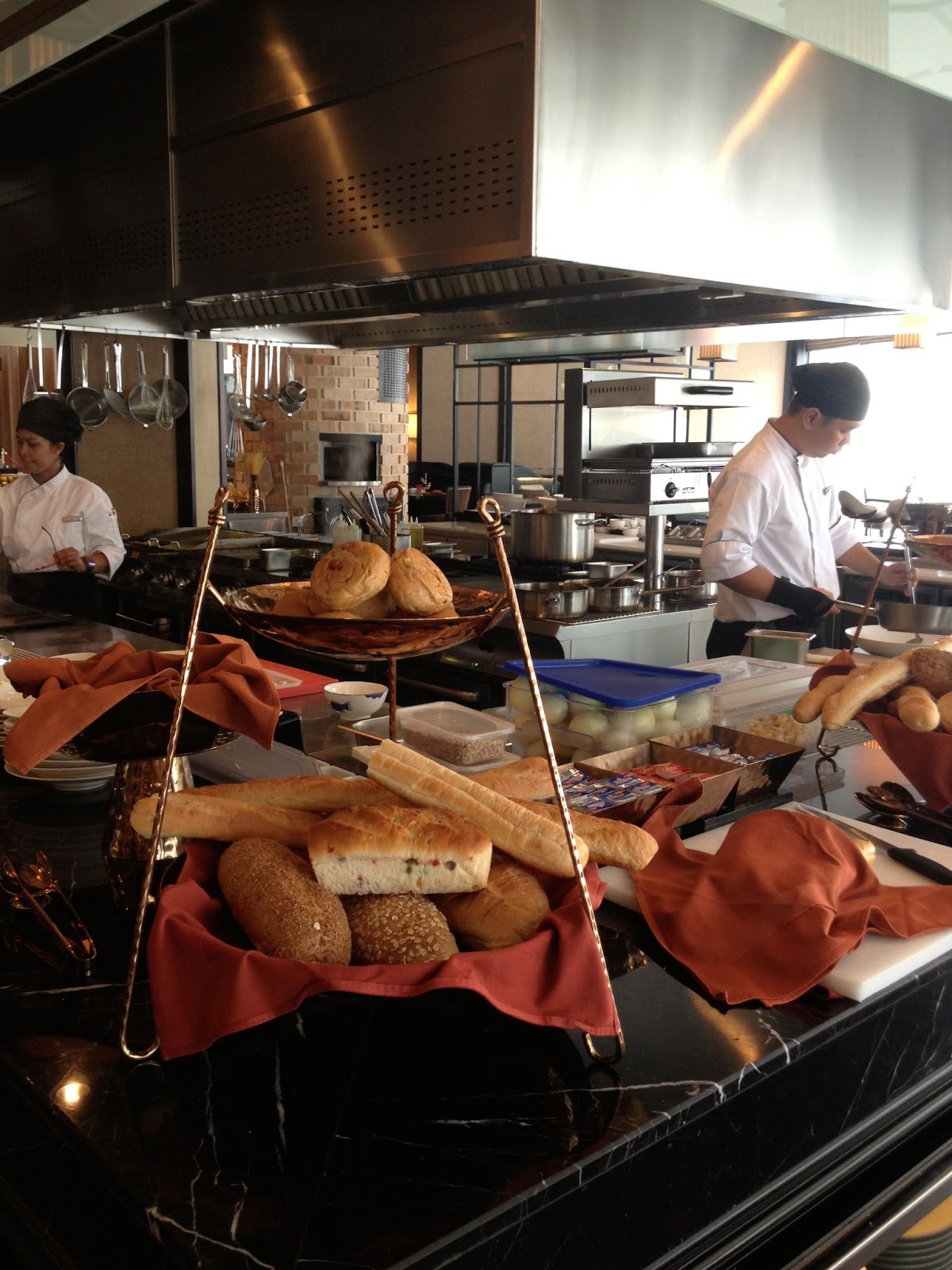
Although the lay out of the restaurant is similar to a buffet of two exclusive stations, it is so much more than a “normal” buffet styled dining. Diners at “Contango” are actually encouraged to speak with the chefs at each cooking stations, and then the chefs would customize the dish to suit each diner’s palate. The two stations offer an International and Asian cuisine.


The Asian Station at Contango

I must say that “Contango” offers a diverse and vast menu. They make their own freshly baked breads, pastas, salads, sushi, ice creams, and there is even a Churrasco. One can literally order anything and the chefs of each station will gladly cook it and serve it up. What’s more, the restaurant changes its menu selection during breakfast, lunch and dinner. Chef Mohammad is constantly challenging himself and his team to create something new while infusing the local flavours with various spices.


Each of Contango’s station invites the diner to create what they like, as they like it. I was most thrilled to find that I could make my own version of “rojak buah” and add the fruits which I liked best. However, my natural gravitational pull was towards the Dessert Bar. “Contango” has an impressive selection of homemade ice creams which range from the usual flavours to “Cempedak”, “Calamansi” and “Durian.”

Delectable Desserts with Berry Sago on Display

My personal favourite at “Contango” is the “Berry Sago Dessert”. You just have to come and taste it for yourself. If you want to fully enjoy this dessert, I strongly recommend that you add a scoop of “Strawberry” ice cream to it. Trust me, it tastes simply divine.

Private Dining Area in The Smoke House
As they say in YTL, “Sometimes the resurrection of a Hotel can herald a second renaissance.” It is indeed a pleasure to welcome back a magnificent structure such as The Majestic Hotel Kuala Lumpur. May “Her Majesty” remain with us for many years to come, so that future generations may also experience its rich heritage. Like a “Sleeping Beauty”, SHE has awakened to stir our long cherished memories and to assist us in making new ones.

So, whether you choose to come to The Majestic Hotel Kuala Lumpur for the glorious food, or you’ve come to savour the history of the hotel, you would no doubt experience something marvelous here. At every corner, lovely surprises await you. Come expecting nothing, but leave with your very own majestic moment.


Friday, January 11, 2013

LOVING OUR SPACES IN THE GREEN WAY


Every Friday, a column in NST RED will feature an article written by me. It's all about the unique spaces which I have come across that provide interesting or unusual experiences. Yes, the stories I write for NST RED can be about anything as long as it is related to spaces/places. After all, the RED in NST RED stands for Real Estate & Decor.

So, this Friday 11th January 2013 - I have written an article about loving our spaces in the green way. It includes an interview with one of our Malaysian talented "Green" Architects, Mr. Kiat Tung. 

As there are always "constraints" in the newspapers' publication, this is the full version with extra pictures and information. 


 LOVING OUR SPACES

Whether we realise it or not, our daily lives are structured around various living spaces – be they online or offline. Every activity of ours is labeled and boxed into each specific space. As our society evolves, our living spaces also undergo changes.


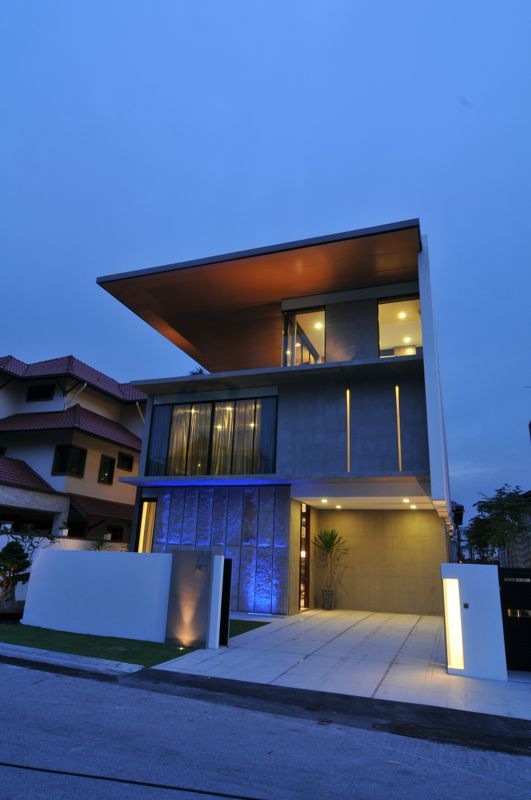
The Modern "C-House"

In our own little space, our evolving lifestyles demand that our living spaces be improved, innovated, and upgraded. We seek to be constantly surprised and wowed. But what does it really mean to enhance our living space? For one, do we even consider the effects our living spaces have on the environment?
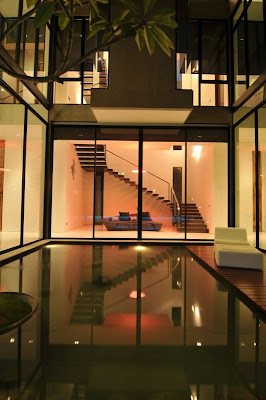
The Water Feature of the "C-House"


Most of us tend to assume that “green” living spaces are very costly. This is perhaps one of the reasons why many have not incorporated the “green” elements into our habitats.


The Night View of the Water Feature


Dispelling ‘costly green’ myth

In order to dispel the myth that creating a “green” living space is expensive, I met up with one of my architect friends, Kiat Tung of T&T Architect Sdn Bhd. Kiat Tung was involved in the drafting of the “Green Building Index Residential Tool” and was once selected as one of the “30 Under 40 Emerging Malaysian Architects”. His specialty is in how to design green buildings without breaking the bank.


Kiat Tung, The "Green" Architect


One of Kiat Tung’s achievements is the “Dream Home Award” for the “C House” he designed and built in Mutiara Damansara. It is essentially a three-storey “green” contemporary house. The “C House” is about 6,000 sq ft in total built-up. The cost of its construction was RM1.2 million, and RM500,000 was spent on the interiors. Kiat Tung also undertook the ID (Interior Design) work for this amazing “green” house.  


These are some of the “green” features of the “C House”:-

a.   Rainwater harvesting system;
b.   Cross ventilation for e.g. the Pond is in the cross ventilation path;
c.    Orientated North-South to minimise heat gain;
d.   Inverter air conditioner system;
e.   Use Low VOC paint;
f.     Optimise natural day lighting;
g.   Minimum window on East and West wall; and
h.   Double cavity wall on the Western wall to reduce heat gain


Living Room of the "C-House"

Kiat Tung shared some of the simplest and cost effective “green” ways which we can easily incorporate into our homes. They are as follows:-


1) Install rainwater harvesting system: This costs about RM2,000 to RM3,000. In Kiat Tung’s opinion, "Bacfree" is a good system because it has complete rainwater harvesting system from filtration to storage. It is almost maintenance-free because the filter will not be clotted due to the design.


The Living Room

2) Install Inverter air-con system: It may cost a few hundred ringgit extra for a single horse power air-con, but we would see a 50 per cent savings in our electricity bills. Inverter is efficient because the motor speed varies depending on demand. Conventional motor runs on constant speed. As a matter of fact, every motor or appliance which has inverter technology installed would be by far more efficient, such as fridges, lift motors etc.


The Other View of the Living Room

3) Zone the air-con areas: For example, compartmentalise the living room so that cool air in living room is contained. Thus, the doors and windows of the room are closed when the air-con is turned on so that the cool air does not leak. The same can be done for the other rooms in the house.


The Balcony at the Top Floor

4) Use low energy bulbs: These can be compact fluorescent bulbs, or LED bulbs. Again, we would enjoy about 20 to 30 per cent savings in our electricity bills as a result.


The Bathroom

5) Cool the roof: Most of the heat comes from the roofs of our houses. Therefore, Kiat Tung suggests using a cooling roof system like “Monier Cool Roof”. It is a ventilated tile roof. There are other brands such as “Cool Roof”, which offers a complete system so that air can be naturally ventilated within the roof to cool down the roof. In normal roofing, hot air is often trapped in the roof itself. 

Night View of the "C-House"


6) Use Low VOC paint: There are no extra costs in procuring these “green” paints. In fact, most generic paints have high VOC (Volatile Organic Compounds). Emissions of VOC from paints are hazardous to our health and the environment.  


The Floating Stairs

As the earth’s natural resources are being depleted with each passing day, Malaysia is not going to be spared. One fine day, everything that fuels our lifestyles may run out. Thus, what we do in each living space will undoubtedly affect the environment at large. It is not a myth that the earth suffers when our daily living “practices” do not promote a “greener” living code of conduct. When the earth becomes afflicted, we would also inherit the same affliction.


Redirecting kitchen waste

Kiat Tung also highlights one of the grave concerns that are harming our environment in Malaysia, as we speak. This is, waste discharge.

Kiat explains, “In most Malaysian houses, the kitchen’s waste discharge goes directly into drainage systems. This is the most common problem in a typical terrace house’s renovation that involves extending the kitchen. For convenience and ease of construction, most contractors would just connect the new kitchen waste discharge to the drain.”

When kitchen waste enters into the drainage system, it would not be treated first, but is released straight into our water systems such as rivers, seas etc. The right method is to connect the kitchen waste discharge into the sewage system. In this way, the waste would be treated first, and then be released into our water systems.

Kiat added, “Kitchen waste discharge from hawker stalls and food courts also pose a similar major problem. This is happening in 95 per cent of our every day corner shop-lots which operate as hawker centres, or what we normally refer to as “Kopitiams”. When there is no proper sewerage discharge for these kitchen wastes, our rivers and water systems would be inevitably polluted. This may be one of the reasons why our Government has to spend billions in cleaning up our rivers and water systems each year.”

Kiat further emphasised, “People are polluting the source and that is, our drains. Not many people are aware that our drains are connected to our rivers, our ponds, and eventually our seas! Grease, oil and cleaning agents kill our marine lives, and our entire eco-system.”

Kiat Tung believes that the best solution is “to create more awareness to the homeowners and hawkers. Local authorities should also be more diligent in demolishing illegal structures set up as restaurants by the roadside.”

In addition, proper Urban Planning is crucial. As Kiat Tung elaborates,  


         "Local authorities should encourage high density development which makes efficient public transport. The remaining forest in Klang Valley should not be gazetted for development. The idea is to use minimum footprint and we should go high or underground. Ideally, the government should demarcate land for development with well connected to public transport eg MRT. The demarcated land should be allowed to develop very high density with plot ratio of minimum 12 and above. The demarcated land should be tendered and awarded to the highest bidder (like what is done in Hong Kong or Singapore). The money collected is then used to buy back land which is not close to public transport and be gazetted as "green lung" or "forest". Gasing Hill is a good example."


Courage to demand better

When we understand how each action will affect others, we would begin to appreciate how the globe is likened to a “fish bowl”. What we consume and discard would invariably go back into this very same earth, this very sacred space we all call home. How each space can become a better living and breathing place is very much dependent on what people do and how they do it.

Above all, it is how much we have invested in that very space. When I say invest – I mean, an investment of heart, time and effort, not just money.

We are the ones who can define every living space by the decisions we make and the things we allow to be put into place. We, as the decision-makers, have the power to decide how we want to enrich our living spaces. After all, we are the very ones who have to live with them or suffer the consequences.

Today, we can scour the web to educate ourselves in order to make wiser decisions on our living spaces. It is definitely possible to create living spaces that reflect our needs, lifestyles, identity, heritage and even our values – without causing further harm to our environment or damaging our bank accounts.

I firmly believe that if we give the same amount of love and care to our living spaces, we would enjoy the beneficial experiences of living in them. Therefore, to live as we would love and vice versa might the key to making every living space of ours meaningful and fulfilling.

All it takes is a little courage to demand for better standards, higher quality and a conscientious attitude towards our environment. We need not surrender to anything less because we know we deserve better. More importantly, we can leave behind a better place for our future generations. 

Here’s to beautiful living spaces that bring meaning and lasting joy to one and all. Until next time, have a fabulous weekend ahead.


My blog has moved!

You should be automatically redirected in 6 seconds. If not, visit
http://shirleymaya.com